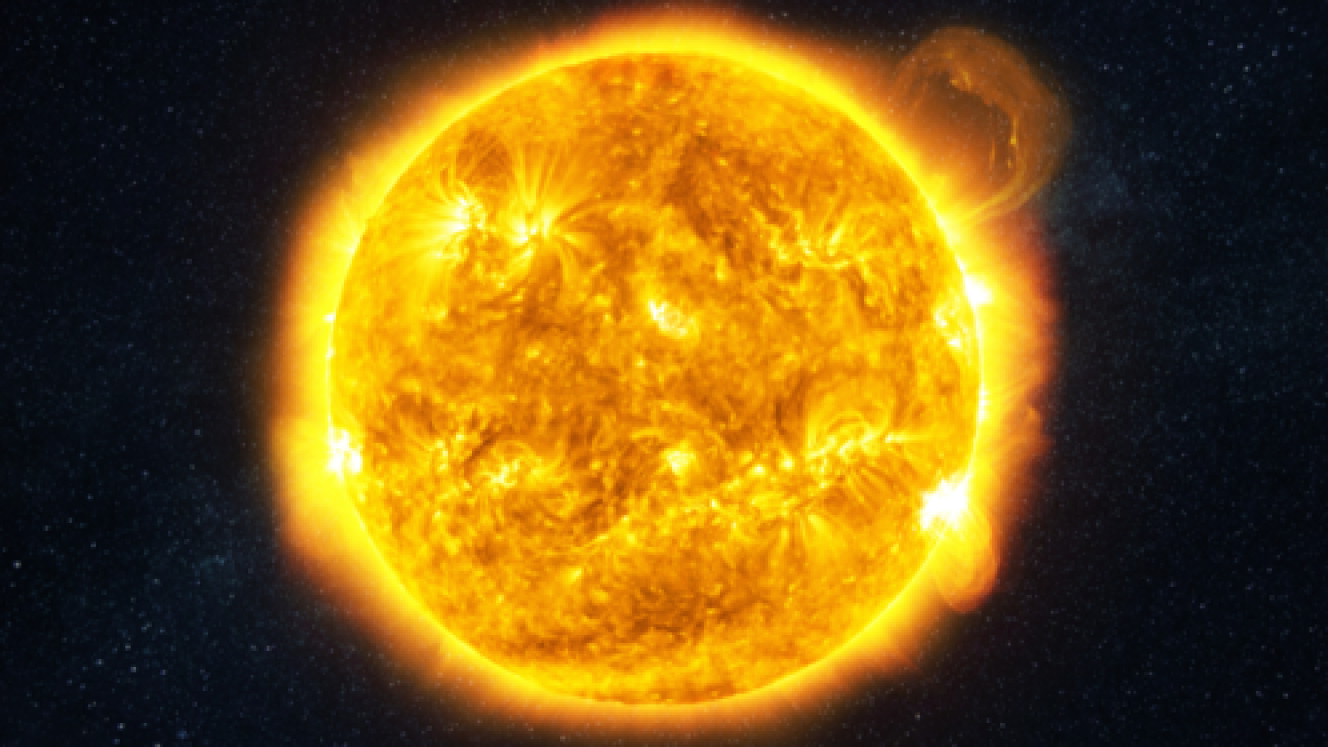
The 1956 Ground Level Event does not have a catchy name and most people have never heard of it. This week marks the 70th anniversary of that extreme space weather event.
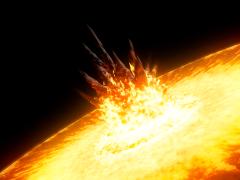
On 23 February 1956, radiation sensors around the world suddenly went haywire as radiation levels spiked to as much as 50 times normal. No one had ever seen anything like it. The radiation came from McMath Region 3400, an enormous sunspot spanning 60° in solar longitude, which flared shortly before the particles arrived. Normally, our atmosphere would harmlessly absorb the radiation. Not this time. Solar particles penetrated all the way to the ground.
“We call this a Ground Level Enhancement (GLE),” explains space scientist Clive Dyer of the Surrey Space Centre. “If it happened again today, it would have a significant impact on air travel and modern technology.” This was the biggest space weather event of the modern era. Even today, nothing has come close to matching it. A widely publicised GLE in November 2025 amounted to only 2% of the 1956 event.
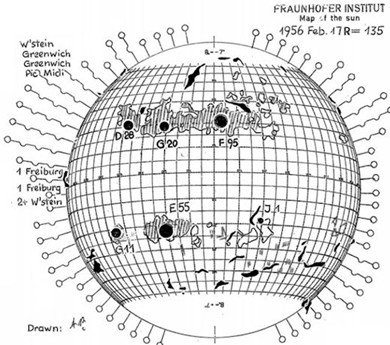
Cosmic ray data was obtained exclusively from ground-level detectors, many of them small and in some cases of non-standard design. All available data from neutron monitors operating in 1956 were analysed to develop a model of the solar cosmic ray behaviour during the event.
The time-dependent characteristics of the cosmic ray energy spectrum, cosmic ray anisotropy, and differential and integral fluxes were evaluated using different isotropic and anisotropic models. The most outstanding features of this proton enhancement were a narrow and extremely intense beam of ultra relativistic particles arriving at Earth just after onset, and an unusually high maximum solar particle energy.
According to Dyer's calculations, GLE05 would have delivered as much as 10 millisieverts of radiation to passengers on high altitude transatlantic flights, comparable to multiple chest CT scans. The effect on satellites might have been significant except for one thing. There were no satellites. Sputnik would not be launched until the following year.
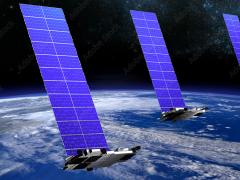
How times have changed. In 2026, Earth is surrounded by a swarm of more than 10 000 active satellites, with electronics so sensitive that even a single particle of hard radiation can reboot onboard computers or burn out memory locations. “Such energetic particle events are nearly impossible to shield,” says Dyer. “We need to be prepared, not if, but when this happens again.”
Hans van de Groenendaal Science and technology writer hans@comsa.africa