South Africa’s youth unemployment crisis remains one of the country’s most pressing structural challenges. With joblessness exceeding 60% among those aged 15–24, meaningful economic participation for young people increasingly depends on access to future-fit skills aligned with a rapidly digitising economy.
In his recent State of the Nation Address, President Cyril Ramaphosa reaffirmed that economic recovery, industrial expansion and competitiveness hinge on developing a skilled workforce capable of supporting growth sectors. Digital capability, in particular, has become a prerequisite for participation across industries.
As a statutory public skills development authority, the Media, Information and Communication Technologies Sector Education and Training Authority (MICT SETA) plays a national coordinating role in closing critical digital skills gaps. Mandated to deploy skills development initiatives within the ICT, and media sectors, the organisation funds and oversees programmes designed to connect unemployed youth with areas of demonstrable labour-market demand.
This includes large-scale interventions in artificial intelligence, cybersecurity, software development, cloud computing and data science; capabilities widely recognised as foundational to the Fourth Industrial Revolution. By aligning training provision with industry needs, these programmes seek not only to improve employability but also to strengthen South Africa’s capacity to attract investment and support innovation-driven growth.
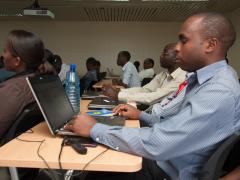
Recent partnerships illustrate the scale and responsiveness of this approach. Collaborative initiatives with universities, training providers and innovation hubs have enrolled unemployed graduates and young people from township and rural communities into intensive programmes combining technical instruction, mentorship and workplace exposure. These interventions embed participants within innovation ecosystems, increasing both employment prospects and entrepreneurial potential.
Evidence suggests that demand-led skills programmes yield measurable outcomes. In several initiatives, the majority of participants transition into employment or income-generating opportunities after completion, particularly where training is paired with practical experience and employer engagement. Such results demonstrate that targeted skills investment can convert public funding into tangible economic participation.
“Our mandate is to ensure that skills development translates into real opportunities for South Africans,” says Matome Madibana, CEO of the Media, Information and Communication Technologies SETA. “By funding industry-aligned programmes in high-demand digital fields, we are enabling young people, especially those from underserved communities to participate meaningfully in the economy and contribute to national growth.”
Beyond employment outcomes, the broader economic implications are significant. South Africa’s digital transformation agenda depends on a pipeline of skilled professionals capable of supporting sectors ranging from telecommunications and financial services to manufacturing, healthcare and public administration. Without this capacity, productivity gains remain constrained and inequality risks deepening.
SETAs therefore serve a strategic function within the country’s economic architecture. By directing levy resources toward scarce and critical skills, they reduce hiring risk for employers, support workforce renewal and help align education outputs with industrial policy objectives. This role is particularly important as businesses adopt new technologies that require specialised competencies.
However, the scale of the challenge remains substantial. While targeted programmes demonstrate strong impact at cohort level, millions of young South Africans remain excluded from formal economic participation. Expanding access to high-quality digital skills training alongside improved foundational education and infrastructure, will be essential to achieving inclusive growth.
As emphasised in the State of the Nation Address, building a capable workforce is central to South Africa’s long-term competitiveness. Skills development interventions that are evidence-based, industry-aligned and scalable can play a decisive role in unlocking growth, stimulating innovation and creating pathways into the labour market.
Madibana reinforced: “Empowering young people with relevant digital capabilities is therefore not merely a social imperative. It is an economic necessity, which is why the MICT SETA has made digital skills development a central pillar of its work”.
Transforming a generation from passive observers of technological change into active contributors to the digital economy will determine whether South Africa can fully realise the opportunities of the Fourth Industrial Revolution.